
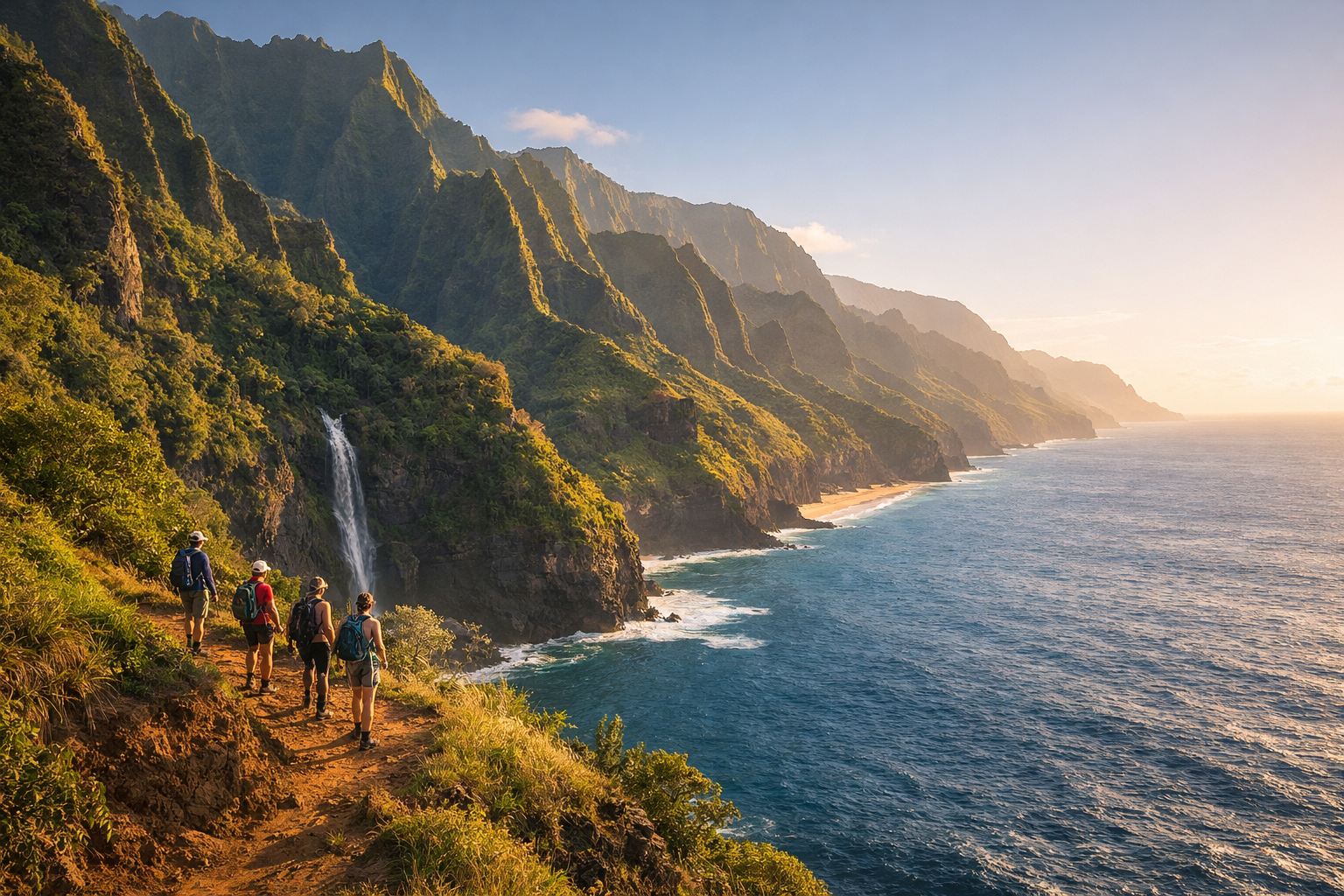
The Kalalau Trail on Kauai’s rugged Na Pali Coast is one of those hikes people place on bucket lists the moment they see the cliffs, waterfalls, and impossibly blue ocean. Writers and travel editors from publications such as National Geographic, Lonely Planet, Travel + Leisure, and Outside Magazine have spotlighted the trail for its dramatic scenery and memorable challenge. This article breaks down what makes the Kalalau Trail special, why it’s considered an out-and-back route where hikers choose their own turnaround point, the hazards to respect, and practical directions for getting to the trailhead at Keʻe Beach.
Why the Kalalau Trail is on so many “must-hike” lists
The Kalalau Trail’s reputation comes from a combination of scenery, variety, and historical significance. The trail travels from the lush forested ridges down to remote beaches and sea cliffs that drop straight into the Pacific. Publications like National Geographic have featured the Na Pali Coast as one of the world’s iconic coastline hikes; Lonely Planet’s guidebooks call the Kalalau Trail a definitive Kauai experience; Travel + Leisure and Outside Magazine frequently include it in roundups of top hikes and coastal adventures.
Those articles highlight several consistent virtues: sweeping ocean vistas, access to waterfalls (like Hanakapiai Falls), a true sense of remoteness, and dramatic terrain that feels very different from mainland hikes. For many hikers, those visual payoffs—especially at Kalalau Beach—make the effort worth it.
Out-and-back by design: pick your distance
One important thing to understand is that the Kalalau Trail is typically treated as an out-and-back route, not a loop. That means you start at the Keʻe Beach trailhead and follow the single trail along the Na Pali Coast; you return the same way. Because the trail is linear and passes several notable destinations, hikers can choose a goal that matches their time, fitness, and risk tolerance.
Common turn-around points
- Keʻe Beach to Hanakapiai Beach — about 2 miles one-way (4 miles round trip). A popular day-hike target when you want a relatively short but scenic outing.
- Hanakapiai Beach to Hanakapiai Falls — continuing another 2 miles inland from Hanakapiai Beach (approximately 4 miles one-way to the falls; 8 miles round trip). The falls are worth the extra effort but require river crossings and steeper terrain.
- Keʻe Beach to Kalalau Beach — about 11 miles one-way (22 miles round trip). Reaching Kalalau Beach is typically a multi-day backpacking trip and requires a backcountry camping permit.
Choosing a destination you can comfortably reach and return from in daylight—and with your level of experience—is the most important planning decision. Many people reach Hanakapiai Beach for a challenging half-day and save the longer trek for when they can spend the night or have stronger fitness and backcountry experience.
Key hazards and why matching difficulty to skill matters
The Na Pali Coast is beautiful but unforgiving in places. Several hazards make accurate self-assessment and preparation essential:
- Steep, exposed sections: Parts of the trail follow narrow ridgelines and cliff edges where missteps can be dangerous.
- Slippery mud and rock: Heavy rain or ocean spray turns sections dangerously slick; good traction is essential.
- Strong currents and shorebreaks: Hanakapiai Beach has powerful surf and no lifeguard. Swimming is hazardous even for strong swimmers.
- Flash floods and stream crossings: Streams like the one to Hanakapiai Falls can spike quickly after rain. Water crossings can be hazardous or impassable.
- Limited rescue access and cell service: Many parts of the trail have weak or no cell coverage, and emergency response can be slow.
- Rockfall and erosion: Natural instability on cliff faces can change trail conditions from season to season.
Because of these risks, hikers should match their objectives to their fitness, footwear, experience with uneven and exposed trails, and ability to navigate in changing weather. If you’re unsure, choose a shorter turn-around (Hanakapiai Beach) or go with an experienced guide. For overnight trips to Kalalau Beach you must obtain a valid backcountry permit and be competent with multi-day pack weight, water treatment, and wilderness camping skills.
Permits and regulations — what to know before you go
Kalalau Beach and the Na Pali backcountry are protected. A backcountry camping permit from the Hawaii Department of Land and Natural Resources (DLNR) is required to camp at Kalalau Beach; day hikers do not need that permit unless they plan to camp. In addition, access and parking at Haʻena State Park (Keʻe Beach) may require reservations or fees—policies have changed over time to manage visitor numbers and protect natural resources.
Always check official resources (Hawaii DLNR and Kauai County/Haʻena State Park notices) for the latest permit, reservation, and trail condition information before planning your hike.
Where the trail starts and how to get there
The Kalalau Trail begins at Keʻe Beach in Haʻena State Park, at the western end of Kuhio Highway (Route 56). Keʻe Beach is located on Kauai’s north shore, beyond the towns of Kilauea and Princeville.
Driving directions — general guidance
- From Lihue Airport or most south-side accommodations, drive north on Kuhio Highway (Route 56) toward Hanalei and Princeville.
- Continue past Hanalei and Princeville; the road follows the north shore cliffs and valleys.
- Keʻe Beach and Haʻena State Park are at the highway’s end. Look for parking and trailhead signage near the beach access area.
Parking at Haʻena can be limited and may be subject to reservation requirements or a shuttle system. Rental car availability, local traffic patterns, and seasonal restrictions can affect travel time; plan extra buffer time and confirm parking/reservation rules in advance.
Practical gear and packing checklist
Whether you’re doing a short out-and-back to Hanakapiai Beach or planning a multi-day to Kalalau Beach, bring appropriate gear. At minimum, carry:
- Sturdy hiking shoes with good traction (no open sandals for long sections)
- Water (plan for at least 2–3 liters per person for a day hike; more for warm days or long distances) and a means to treat/filter water for longer trips
- Rain jacket and layered clothing (weather changes quickly)
- Sunscreen, hat, and sunglasses
- Snacks and extra food
- First-aid kit, map, and a charged phone or emergency beacon
- For camping: lightweight shelter, sleeping gear, fuel, and permits
Best time to go and weather considerations
The dry season (generally spring through early fall) often provides the most stable trail conditions, but the Na Pali Coast can receive intense, localized rain at any time of year. Check the weather forecast, look for local trail condition reports, and avoid river crossings after heavy rain. Morning starts help you avoid afternoon sun and give more daylight margin for return hikes.
Responsible hiking: Leave no trace
The Na Pali Coast is ecologically sensitive and culturally significant. Pack out all trash, stay on the trail, avoid disturbing plants and wildlife, and follow all posted rules. Respect private and cultural sites along the route.
Key takeaways
- The Kalalau Trail is an iconic Na Pali Coast hike that offers options for short day trips (Hanakapiai Beach), moderate day hikes (Hanakapiai Falls), and strenuous multi-day backpacking to Kalalau Beach.
- It’s an out-and-back trail: choose a realistic turn-around point based on fitness and experience.
- There are real hazards—steep, slippery sections, strong surf, and flash floods—so prepare, check conditions, and match your plan to your skills.
- Start at Keʻe Beach in Haʻena State Park; check current parking, reservation, and permit rules before you go.
Frequently asked questions
Do I need a permit to hike the Kalalau Trail?
You do not need a backcountry camping permit for a day hike that turns around at Hanakapiai Beach or Hanakapiai Falls. A DLNR backcountry permit is required to camp at Kalalau Beach or to remain in the backcountry overnight. Separate parking or entrance reservations at Haʻena State Park may also be required—confirm before you travel.
How long does it take to reach Kalalau Beach?
Keʻe Beach to Kalalau Beach is about 11 miles one-way. Most people treat it as an overnight backpacking trip. Fitness and pack weight determine pace: a fit hiker may cover the distance in a long, fast day, but overnight camping is the safer and more common approach.
Is the trail suitable for beginners?
Short sections (to Hanakapiai Beach) can be completed by fit beginners with proper footwear and caution. The full trail and sections with steep, exposed terrain are best for experienced hikers. When in doubt, choose a shorter objective and use a guide if you’re unfamiliar with rugged coastal trails.
Are there guided tours available?
Yes—local companies offer guided day hikes and multi-day guided backpacking trips. A guided option can add safety, local knowledge, and logistics (permits, camping setup) for hikers who prefer support.
Is there cell service on the trail?
Cell coverage is unreliable and often absent in many parts of the Na Pali Coast. Don’t rely on phone service for navigation or emergency communication; consider carrying an emergency beacon or satellite messenger for longer or riskier trips.
Ready to plan your Kalalau adventure?
If you’re thinking about hiking the Kalalau Trail, start by deciding which destination suits your experience—Hanakapiai Beach or Falls for a day, Kalalau Beach for a permitted overnight—and check current permit and parking rules. Want gear recommendations for coastal hikes and lightweight overnight packs? Browse our LINKfit shop’s curated hiking essentials and sign up for our newsletter for practical trip-planning tips, packing lists, and safety briefings.