
Most of us think of music as a mood-lifter or a distraction during a workout. Increasingly, research suggests it can be much more: a tool that changes how you perform, how hard the effort feels, and even the physiological output of your training. In short, the songs you pick for yoga, sprint intervals, or a heavy lifting session may be shaping the results you get. Below we’ll review what science says, explain how to match music to different types of exercise, and give practical steps to upgrade your playlists so they work for your goals.
How music interacts with exercise: the basic mechanisms
Research identifies several ways music influences exercise performance:
- Rhythmic entrainment: Your nervous system tends to synchronize movement to an external rhythm. When cadence and beat match, efficiency and coordination often improve.
- Psychological arousal and motivation: Up-tempo, familiar, or personally meaningful tracks raise arousal and motivation levels that can translate into more forceful or sustained effort.
- Perceived exertion (RPE) reduction: Music can distract attention from internal sensations of fatigue, making effort feel easier at the same workload.
- Emotional regulation and recovery: Slow, calming music lowers stress markers and aids breathing and recovery during cooldowns or yoga.
What studies actually show
Below are representative findings from the research literature. These are not exhaustive, but they capture the consistent patterns scientists have observed.
1. Synchronization helps endurance and pacing
Styns et al. (2007) famously demonstrated how people naturally match walking cadence to musical tempo. Subsequent work shows the same principle applies to running and cycling: music with a steady beat helps participants maintain cadence and can improve efficiency or pacing over sustained efforts. In practice, music that matches your movement rhythm reduces the mental cost of pacing and often improves endurance outcomes.
2. Motivational music raises power and reduces perceived effort
Reviews and experimental studies summarized by Karageorghis & Priest (2012) report that motivational music—tracks that are fast, loud enough, familiar and liked—can increase power output and lower ratings of perceived exertion (RPE) during both aerobic and resistance exercise. In short, when people listen to motivating music they tend to push harder while feeling like they are exerting less.
3. Tempo and genre matter for activity type
Experimental work comparing synchronous (beat-matched) vs. asynchronous music shows that synchronous music is especially effective for rhythmic activities such as running, rowing, cycling, and walking. For tasks demanding maximal strength or short bursts (e.g., heavy lifts or sprints), high-arousal music (strong beat, high tempo, motivational lyrics) tends to increase aggression and power for short durations.
4. Slow music aids recovery and relaxation
Music therapy and clinical studies (e.g., Nilsson and colleagues) show calming music lowers heart rate, blood pressure, and subjective anxiety. For yoga, mobility sessions, and cooldowns, low-tempo, minimal-lyric music supports breathing patterns and parasympathetic activation—helpful for recovery and stress reduction.
Bottom line from the literature: Music can and does change both subjective experience (how hard exercise feels) and objective performance (power, endurance, pacing), but the effect depends on matching music characteristics to the exercise.
Match music to the type of workout
Rather than one universal playlist, think in categories. Below are practical, evidence-aligned recommendations for common workout types.
-
Yoga, mobility, and cooldowns
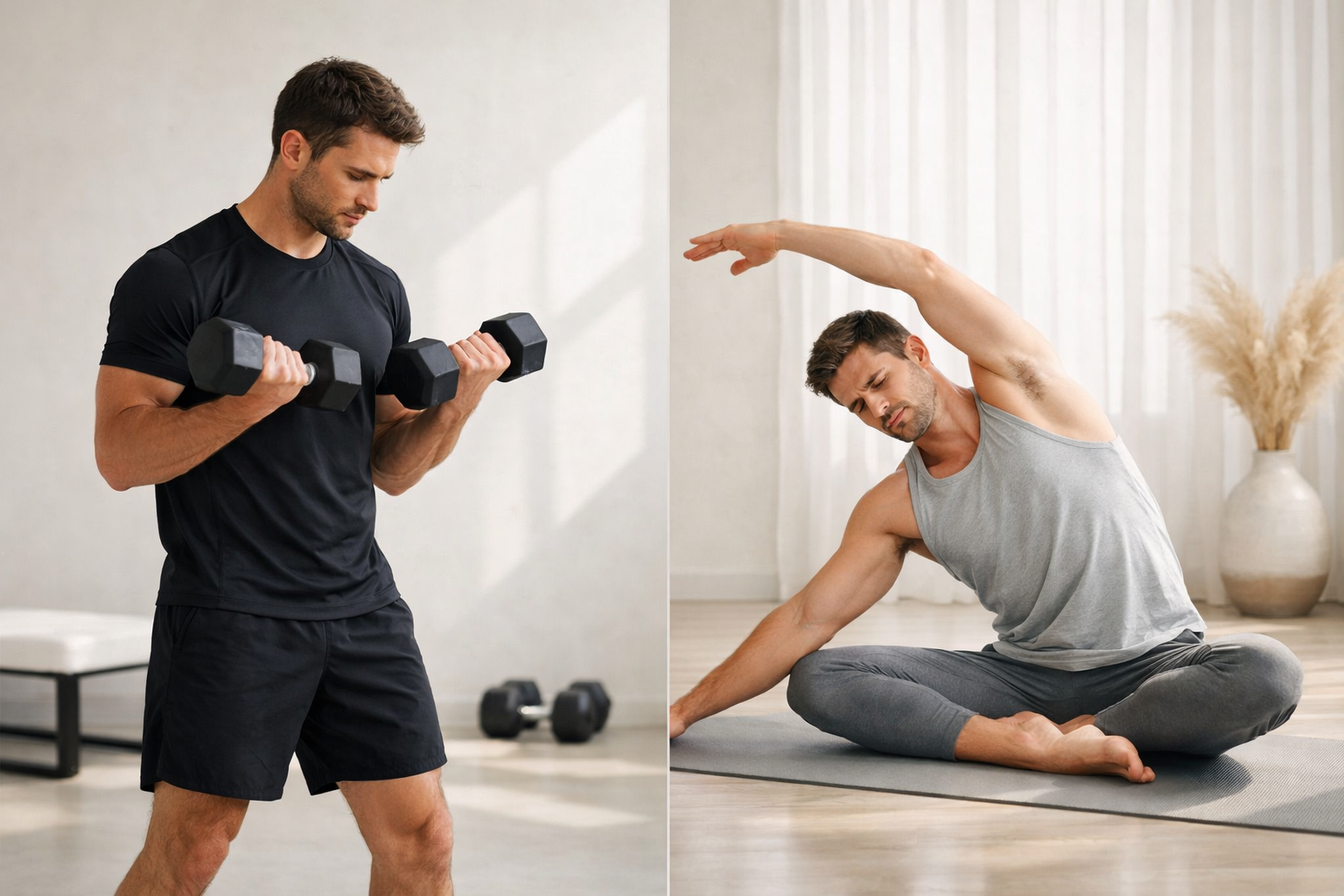
Choose slow (about 60–80 BPM), ambient, or acoustic tracks with minimal lyrics. The aim is to support slow breathing and relaxation. Lower volume and predictable harmonic progressions help maintain focus on the body and breath.
-
Steady-state cardio (easy runs, cycling)
Use mid-tempo music that matches your cadence (e.g., 120–140 BPM for many runners). Tracks with a steady rhythm support consistent pacing and make longer sessions feel less effortful.
-
HIIT and sprints
High-energy, high-tempo tracks (140–180+ BPM) with strong percussion enhance intensity and help you hit maximal efforts during intervals. Use music to structure intervals—songs for work periods and calmer tracks for rest.
-
Strength training
Tempo here depends on the lift and goal. For heavy singles and maximal attempts, choose high-arousal, motivational songs to increase aggression and focus. For hypertrophy or controlled reps, steady mid-tempo tracks can aid rhythm and breathing between sets.
-
Group classes and circuit training
Use playlists that progress in energy with the class. Beat-matched music improves synchronization in group movements and keeps transitions smooth.
How to build better workout playlists—practical steps
- Define the session goal. Is this a recovery day, tempo run, or max lift? Your music should serve the goal, not just your mood.
- Match tempo to movement. Use BPM-matching tools on streaming platforms or apps that detect song BPMs to align beat and cadence.
- Prioritize familiarity and preference. Research shows you get more performance benefit from music you like or know well.
- Use arousal strategically. Save extremely high-arousal songs for warm-ups and key sets or intervals; use calmer selections for steady work and cool-downs.
- Test and measure. Try swapping your usual playlist for a beat-matched, goal-specific list for several sessions and note differences in RPE, pacing, or lift readiness.
- Keep safety in mind. If you’re training outside, keep volume moderate or use one earbud so you stay aware of traffic and surroundings.
Common pitfalls to avoid
- One playlist for everything: A single playlist for all workouts dilutes the potential benefit—different sessions need different music cues.
- Too loud: Excessive volume can damage hearing and reduce environmental awareness.
- Distracting lyrics: For technically demanding movements, overly lyrical or narrative music can pull focus away from form.
- Over-reliance: Music is a tool. Training fundamentals — progressive overload, recovery, nutrition — still drive results.
Key takeaways
- Scientific reviews and experiments show music influences both subjective effort and objective performance when matched to the activity.
- Synchronization (matching beat to movement) is powerful for rhythmic exercise; motivational, high-arousal music benefits short, intense efforts and heavy lifts.
- Slow, calming music aids recovery and supports breathing during yoga and cooldowns.
- Test goal-specific playlists for a few sessions—small changes in music selection can yield meaningful changes in pacing, power output, and perceived exertion.
Frequently asked questions
Will music actually make me stronger or just feel easier?
Both. Studies show music can reduce perceived exertion and increase output in tasks like running, cycling, and certain strength efforts. The psychological boost (motivation/arousal) often translates into measurable increases in power or duration, especially for short or high-intensity efforts.
Is instrumental music better than songs with lyrics?
It depends on the task. For technically demanding lifts or movements requiring focus, instrumental or less lyrically dense music reduces distraction. For motivation during intervals or heavy singles, lyrics you find energizing can help. Personal preference matters.
How do I find the right BPM for my workouts?
Many streaming services and fitness apps tag songs with BPM. For walking and easy runs, 100–140 BPM is common; for HIIT and sprints, 140–180+ BPM; for yoga and cooldowns aim for 60–80 BPM. Use these ranges as starting points and adjust based on how the music affects your pace and perceived effort.
Are there risks to working out with music?
Major risks are hearing damage from high volume and reduced environmental awareness outdoors. Keep volume reasonable, consider single-earbud options for outside training, and avoid relying solely on music cues for pacing in technically complex or safety-sensitive situations.
Call to action
Ready to experiment? Try swapping one workout’s playlist this week for a goal-specific, beat-matched list and track how your pace, RPE, or lift readiness changes. If you want a head start, explore LINKfit’s curated playlists and training gear to match your session style—find what clicks and let your music work as hard as you do.