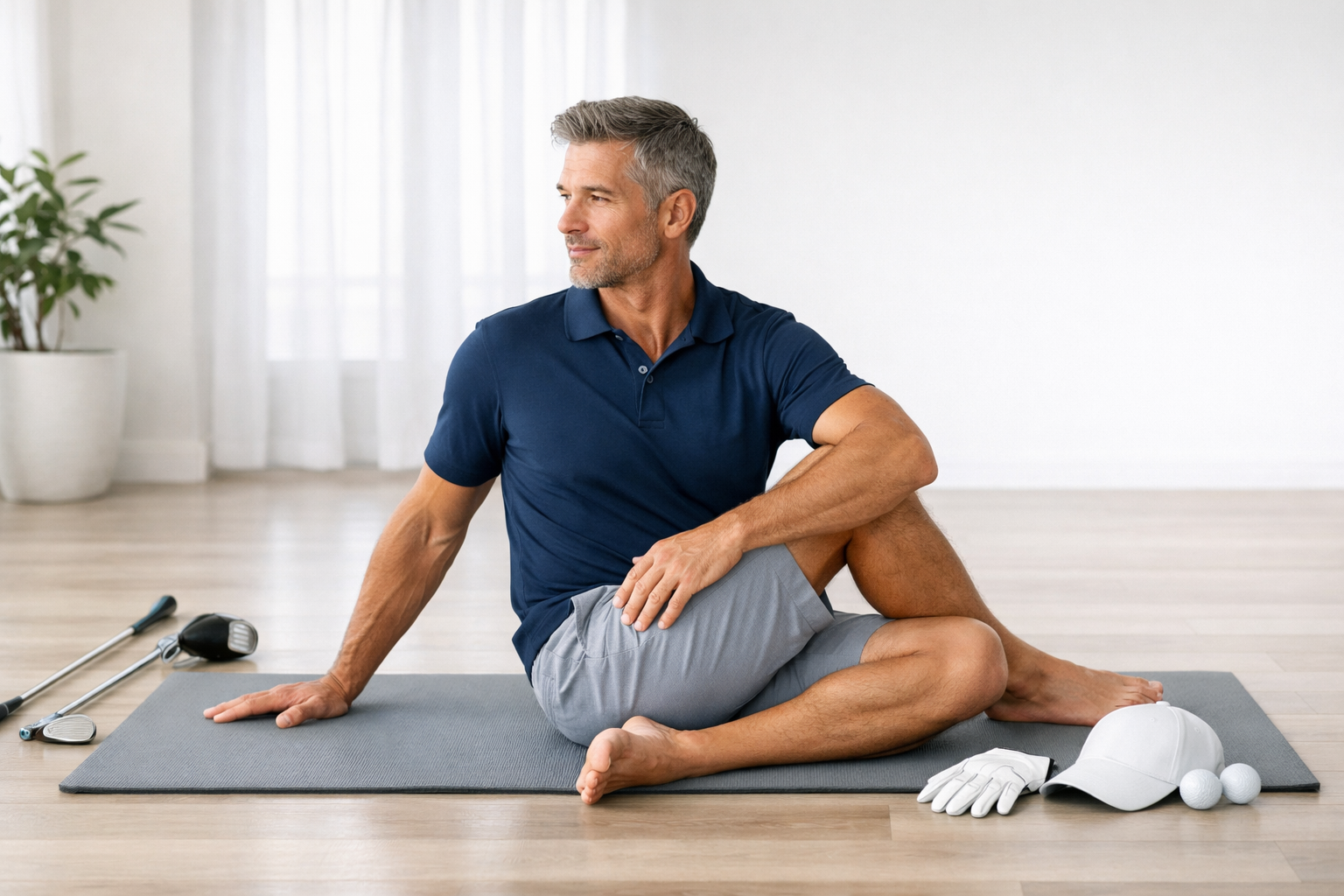
This golfer’s yoga routine is built around simple, repeatable poses that help you move better through your warm-up, recovery, or off-day mobility work. The goal here is straightforward: know what each pose is, how to get into it, and how to keep it clean and comfortable. You do not need to be flexible to start. You just need a mat, a little space, and a few minutes of focus.
If you are brand new, move slowly and choose the easiest version of each shape. If you already train regularly, use the same routine as a mobility reset after lifting, walking, or playing 18 holes.
General rule: breathe smoothly, avoid forcing range of motion, and come out of any pose that causes sharp pain.
How to use this routine
You can work through these poses in order, holding each one for 3 to 5 slow breaths. If you want a shorter session, pick 5 or 6 poses and stay with the ones that feel best in your body. For a fuller routine, complete all of them once on each side where applicable.
The poses
1. Cat-Cow
Cat-Cow is a gentle spinal movement that warms up the back and helps you connect breath with motion. It is usually done on hands and knees.
- Start on your hands and knees with your wrists under your shoulders and your knees under your hips.
- Press your palms into the floor and keep your neck long.
- As you inhale, drop your belly slightly, lift your chest, and let your tailbone tip upward for Cow.
- As you exhale, round your spine, tuck your chin slightly, and draw your belly in for Cat.
- Continue moving slowly between the two shapes for 5 to 8 rounds.
Keep the movement smooth rather than exaggerated. Think of it as waking up the spine, not forcing it.
2. Thread the Needle
Thread the Needle is a simple floor twist that opens the upper back and shoulders. It is especially useful if you spend time hunched over a desk, steering wheel, or golf bag.
- Start in a table-top position on your hands and knees.
- Slide your right arm under your left arm, palm facing up.
- Lower your right shoulder and the side of your head toward the floor.
- Keep your left hand planted for support or walk it forward to deepen the stretch.
- Hold for several breaths, then slowly return to center and switch sides.
Do not collapse into the shoulder. The idea is to rotate and open, not to dump all your weight into one side.
3. Low Lunge
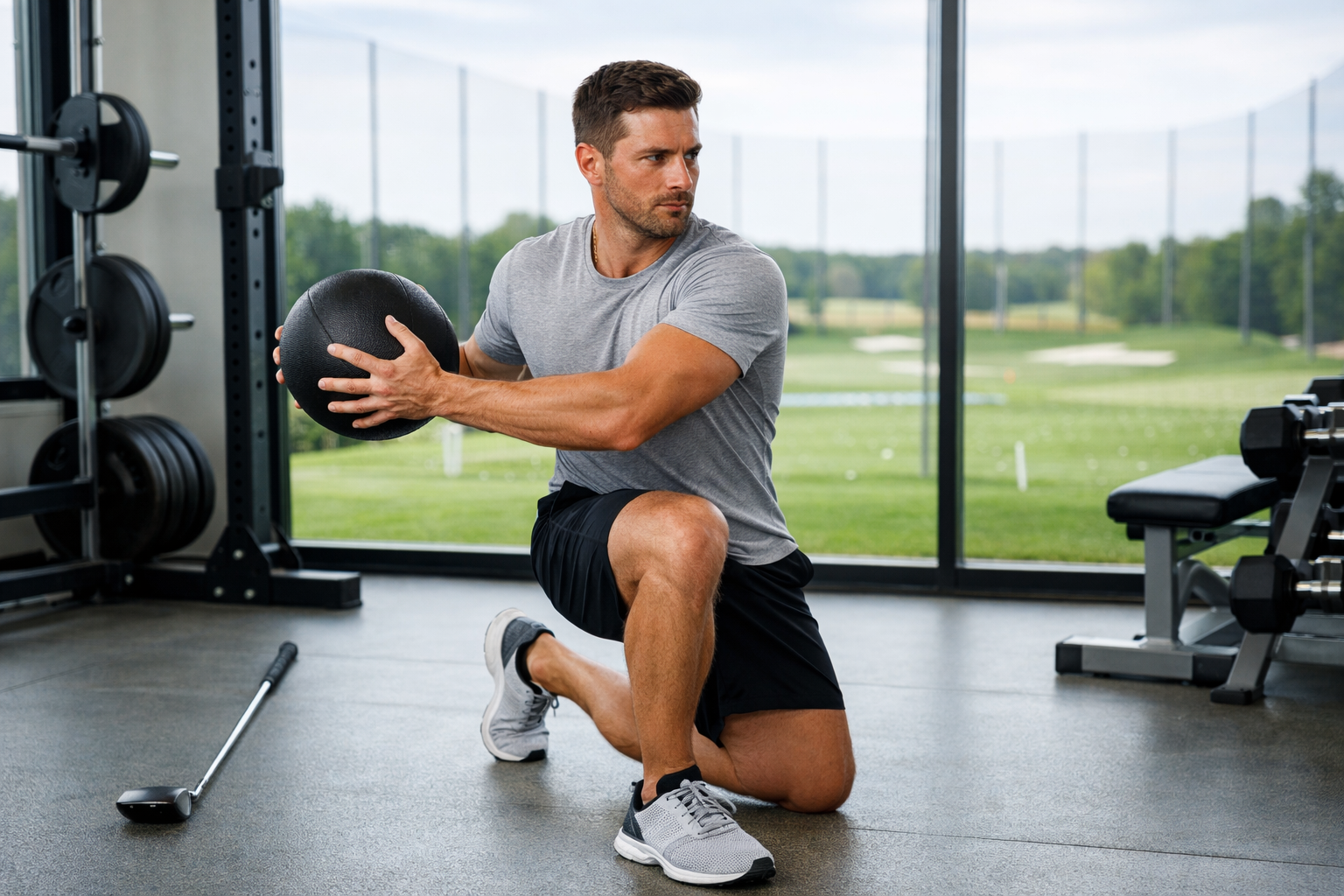
Low Lunge is a kneeling position that puts the hips into a long, steady stretch. It is a basic shape, but it is one of the most useful in a golfer’s routine because it is easy to modify and easy to feel.
- From hands and knees, step your right foot forward between your hands.
- Lower your left knee to the floor and slide it back until you feel a comfortable stretch through the front of the left hip.
- Keep your front knee stacked over your ankle.
- Place your hands on the floor, on blocks, or on your front thigh.
- Lift your chest gently and breathe for 3 to 5 breaths before switching sides.
If your back knee is sensitive, place a folded towel or cushion underneath it.
4. Revolved Low Lunge
Revolved Low Lunge adds a controlled twist to the basic lunge shape. This is a good way to keep the lower body grounded while the upper body learns to rotate.
- Begin in Low Lunge with your right foot forward and left knee down.
- Bring both hands to your right thigh or bring your palms together at your chest.
- As you inhale, lengthen your spine.
- As you exhale, rotate your chest gently to the right, keeping your hips as level as possible.
- Stay tall rather than cranking your shoulders too far around.
Keep the twist open and spacious. If balance feels shaky, keep both hands on the front thigh instead of lifting them up.
5. Half Split
Half Split is a hamstring-focused shape done from a lunge position. It gives you a clean way to fold at the hips while keeping the spine long.
- Start in Low Lunge with your right foot forward.
- Shift your hips slightly back and straighten your front leg as much as is comfortable.
- Flex your front foot so your toes point up.
- Keep your hands on the floor, on blocks, or on your front shin.
- Lengthen your spine first, then hinge forward only as far as you can without rounding aggressively.
Do not lock the front knee. A soft bend is fine if that helps you keep the movement smooth and controlled.
6. Lizard Pose
Lizard Pose is a deeper hip-opening lunge with a wider stance. It is a useful shape for working into the outer hips and groin area while keeping the upper body relaxed.
- From a high lunge, bring both hands to the inside of your front foot.
- Set your back knee down if you want a more accessible version.
- Keep your front foot planted and spread your fingers wide on the mat.
- Lower onto your forearms if that feels steady and comfortable.
- Hold the shape without bouncing, breathing evenly the whole time.
If your hips are tight, keep the back knee down and stay on your hands. You do not need the deepest version to get a strong, useful stretch.
7. Chair Pose with Twist
Chair Pose with Twist is a standing position that combines lower-body engagement with torso rotation. It is a practical way to rehearse the kind of control and balance many golfers want in their movement.
- Stand with your feet about hip-width apart.
- Bend your knees and send your hips back as if you are sitting into a chair.
- Keep your weight in your heels and lift your chest.
- Bring your hands together at your chest.
- Twist your upper body gently to one side, placing one elbow across the opposite thigh if it feels stable.
Keep both feet grounded. If the twist makes you lose balance, reduce the rotation and stay more upright.
8. Standing Forward Fold
Standing Forward Fold is a simple fold that lets the back body lengthen while giving the neck and shoulders a break. It can be done as a gentle reset between more active poses.
- Stand tall with your feet about hip-width apart.
- Hinge at your hips and fold forward slowly.
- Let your knees bend as much as needed so your back can stay relaxed.
- Let your arms hang, rest your hands on your shins, or hold opposite elbows for a relaxed ragdoll variation.
- Stay for several breaths and rise slowly when you are ready.
This is not about touching the floor. It is about folding in a way that feels steady and easy to control.
9. Reclined Figure Four
Reclined Figure Four is a floor-based glute stretch that is easy to control and gentle on the joints. It is one of the most beginner-friendly ways to open the hips.
- Lie on your back with both knees bent and feet on the floor.
- Cross your right ankle over your left thigh, just above the knee.
- Keep the right foot flexed to protect the knee.
- Reach behind your left thigh and gently draw the legs toward you.
- Hold for a few breaths, then switch sides.
If you cannot reach your thigh comfortably, keep the bottom foot on the floor and simply hold the crossed-leg shape there.
10. Sphinx Pose
Sphinx Pose is a low backbend done on the stomach with the forearms on the floor. It is a calm way to extend the front of the body without needing a big range of motion.
- Lie face down with your legs long behind you.
- Place your elbows under your shoulders and your forearms parallel on the floor.
- Press gently through the forearms and lift your chest slightly.
- Keep the tops of your feet down and your shoulders away from your ears.
- Breathe into the front ribs and keep the pose soft, not forceful.
If your lower back feels pinched, come down a little and reduce the lift. Sphinx should feel spacious, not compressed.
11. Child’s Pose with Side Reach
Child’s Pose with Side Reach is a resting position that also gives the sides of the torso a gentle opening. It is a good way to finish the routine and bring the breathing back down.
- From hands and knees, sit your hips back toward your heels.
- Stretch your arms forward on the mat or rest them alongside your body.
- Walk both hands a little to the right to stretch the left side of the body.
- Hold for several breaths, then walk the hands through center and over to the left.
- Finish by settling into the center with easy, relaxed breathing.
Keep your hips as comfortable as possible. If sitting back on the heels is too much, place a cushion between your hips and heels or keep the knees a little wider.
Key takeaways
- Start simple. Basic shapes done well are more useful than forcing advanced versions.
- Move with breath. Slow breathing helps the routine stay controlled and repeatable.
- Use props if needed. Blocks, towels, and cushions make each pose more accessible.
- Stay out of pain. Mild stretch is normal; sharp pain is a sign to back off or stop.
- Consistency matters. A short routine done often is usually easier to maintain than a long session done rarely.
Frequently asked questions
How long should this routine take?
If you move steadily and hold each shape for a few breaths, the routine can take about 10 to 20 minutes. You can also shorten it by choosing just a few poses that match what your body needs that day.
Can beginners do these poses?
Yes. These poses are beginner-friendly as long as you keep the range of motion moderate and use props when needed. The easiest version of each pose is a perfectly valid version.
Should I do this before or after golf?
You can do it either way. Before golf, keep the holds shorter and the movement more active. After golf, slow down and stay in each pose a little longer if it feels good.
What if a pose feels awkward?
Make it smaller. Bend your knees, place your hands on blocks, or stay in an easier variation. Yoga is not about forcing a shape; it is about building a better one for your body.
Do I need a yoga background to get started?
No. If you can breathe and move slowly, you can do this routine. The more regularly you practice, the more natural the transitions will feel.
Final thoughts
A golfer’s yoga routine does not need to be complicated to be useful. These poses give you a clear, practical way to move through the spine, hips, shoulders, and legs with more awareness and less guesswork. Keep the routine simple, repeat it often, and let your body set the pace.
Call to action
Like this article? Please share it. Also, register to follow LINKfit and receive our latest articles once a week. LINKfit – Show up.